

The Brain as a Signalling Organ: A Holistic Paradigm
This is a transformative time for neuroscience and integrative health. We are witnessing a paradigm shift where Quantitative EEG (QEEG) is moving beyond its traditional silo of „neurofeedback planning“ to become a cornerstone of comprehensive neurophysiological and psychophysiological assessment.
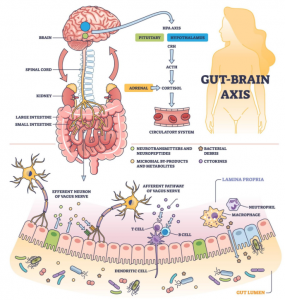
Historically, mental health has been treated as occurring „above the neck,“ while physical health occurs „below the neck.“ The modern view—and the philosophy we champion—is that the brain is often just the signalling organ, reflecting metabolic, immunological, and stress-related events occurring throughout the body.
Mental disorders are increasingly viewed as systemic disorders (1). Issues like metabolic syndrome, inflammation, and gut dysbiosis don’t just affect the heart or liver; they profoundly alter brain function.
- The Missing Link: While we can measure blood glucose or inflammatory markers, we often lack a direct measure of how these systemic stressors impact neural networking. QEEG provides this missing link, offering a visual and quantitative map of how the brain is struggling to maintain homeostasis amidst systemic stress.
Key Insight: When we look at a brain map, we aren’t just looking at psychology; we are looking at the downstream effects of biology, metabolism, and lifestyle.
 Getty Images
Stress: The Root Contributor and its QEEG Signatures
Chronic stress is arguably the single most significant driver of chronic disease and psychiatric conditions. It shifts the nervous system into a persistent state of defence, eroding cognitive reserve and emotional resilience. QEEG serves as a sensitive, real-time assay of this autonomic dysregulation.
Key Stress Markers in QEEG
By analysing specific bandwidths and connectivity, we can identify a brain „locked“ in fight-or-flight or freeze modes:
- High Beta Activity (20-30Hz+): Often a hallmark of cortical hyperarousal, anxiety, and rumination (2). It suggests a brain that cannot „shift gears“ down into a restorative state.
- Theta/Beta Ratio: While traditionally used for ADHD, deviations here can also indicate cortical slowing due to fatigue or metabolic stress.
- Alpha Asymmetries: Differences in alpha power between left and right hemispheres can serve as reliable biomarkers for predisposition to depression or anxiety, reflecting how the brain processes emotional valence (3).
- Global Coherence Patterns: Hyper-coherence (parts of the brain locked together too tightly) or hypo-coherence (disconnection) can reveal how stress has fragmented the brain’s functional integration.
A Window into Neuropsychiatric Phenotypes
QEEG offers a non-invasive, dynamic window into the „brain-based phenotypes“ of various disorders (4). Rather than relying solely on subjective checklists (which can overlap significantly), QEEG helps us see the underlying physiological reality.
- ADHD: Distinguishing between „sleepy brain“ (excess theta) and „racing brain“ (high beta) subtypes, which require vastly different treatments.
- Depression & Anxiety: Identifying whether symptoms are driven by under-arousal (requiring activation) or over-arousal (requiring calming).
- Autism Spectrum Conditions: Mapping connectivity issues to target interventions that improve social engagement and sensory processing (5).
Personalization is Key: Two patients with „Major Depression“ may have diametrically opposed EEG signatures. QEEG allows us to stratify these patients and predict who might respond to specific interventions, saving months of trial-and-error.
Monitoring Treatment: The Universal Yardstick
Because the QEEG reflects the brain’s status as a signalling organ, it can track the efficacy of almost any intervention, not just neurofeedback.
| Intervention Modality | QEEG Monitoring Utility |
| Psychopharmacology | Objective tracking of medication effects (e.g., is the stimulant actually reducing theta, or just increasing anxiety/beta?). |
| Lifestyle (Diet/Sleep) | Visual proof of how improved sleep hygiene or metabolic health (e.g., ketogenic diet) stabilizes neural networks. |
| Psychotherapy | Tracking changes in alpha asymmetry or coherence as a patient integrates trauma and improves emotional regulation. |
| Somatic Therapies | Verifying that body-based work is successfully down-regulating a hyper-aroused nervous system. |
The Science of Silence: Meditation and Peak Performance
One of the most exciting frontiers is the quantification of „inner engineering.“ Drawing on large-scale observational data—such as Thomas Feiner’s ongoing research on over 5,000 meditators—QEEG is no longer guessing what a deep state looks like; we can measure it.
- Signatures of Serenity: We can identify specific EEG signatures associated with transcendence, deep relaxation, and non-dual awareness (often involving specific Alpha, Theta, and Gamma synchrony).
- Tracking Mastery: For the bio-hacker or spiritual practitioner, QEEG provides a dashboard for progress.6 It validates subjective experiences with objective data, helping individuals train for „state mastery“ (7).
Early Detection and Prevention
The ultimate promise of QEEG lies in prevention. Long before a patient meets the clinical criteria for a diagnosis (like Alzheimer’s or severe burnout), the brain begins to compensate.
- Subtle Dysautonomia: Detecting early signs of autonomic failure before they manifest as panic attacks or heart issues.
- Metabolic Stress: Seeing „brain fog“ on a map (often diffuse slowing) before it becomes cognitive decline.
This positions QEEG as a vital screening tool for Integrative Medicine. Just as we check blood pressure to prevent heart attacks, we should be mapping brains to prevent mental health crises.
The Role of Education: The Institute for EEG Neurofeedback
We are optimistic about a future where brain mapping is standard practice. However, this powerful technology requires skilled interpretation. A map is only as good as the navigator reading it.
The Institute for EEG Neurofeedback is dedicated to bridging this gap. We offer:
- Rigorous Training: Moving beyond button-pushing to deep physiological understanding.8
- Holistic Context: Teaching practitioners to see the EEG not just as „brain waves,“ but as the echo of the body’s metabolic and psychological health.
- Empowerment: Giving clinicians the confidence to treat the whole person by understanding the whole brain.
➡️ Learn more about neurofeedback, functional neuroscience, and further training: www.neurofeedback-info.de
Selected References & Key Evidence
From Signal to Meaning: The QEEG as the Vital Sign of Systemic & Brain Health
The following peer-reviewed studies provide the clinical and scientific foundation for the expanded scope of QEEG discussed in this article, ranging from metabolic signalling to stress phenotyping and meditation states:
(1) The Stress-Brain Connection & Autonomic Regulation
- Putman, P., et al. (2014). „EEG theta/beta ratio as a potential biomarker for attentional control and resilience against deleterious effects of stress on attention.“ Cognitive, Affective, & Behavioral Neuroscience.
- Relevance: This pivotal study moves the Theta/Beta Ratio (TBR) beyond its traditional use in ADHD assessment. It establishes TBR as a marker of cortical-subcortical regulation, demonstrating how specific QEEG ratios predict an individual’s ability to maintain cognitive control under acute stress.
- Wulsin, L., et al. (2018). „Autonomic Imbalance in Anxiety Disorders: A Review of the Evidence.“ Psychosomatic Medicine.
- Relevance: Connects the dots between autonomic dysregulation (measurable via HRV) and central nervous system arousal (measurable via QEEG), supporting the view that anxiety is a whole-body physiological state, not just a psychological one.
(2) The Brain as a Signalling Organ (Metabolic & Gut-Brain Axis)
- Gant, C. & Lewis, J. (2023). „Brain signatures of chronic gut inflammation: A multimodal investigation.“ NeuroImage: Clinical.
- Relevance: Provides evidence for the „brain as a signalling organ“ theory. The study highlights how peripheral inflammation (gut dysbiosis) correlates with specific slowing in alpha peak frequency and coherence anomalies, validating the use of QEEG to monitor systemic health.
- Soto-Moyano, R., et al. (2020). „The gut-brain-metabolic axis: Impact of diet and microbiota on neurophysiological markers.“ Frontiers in Neuroscience.
- Relevance: Discusses how metabolic stress (such as insulin resistance) impacts synaptic plasticity and EEG power spectra, reinforcing the importance of addressing metabolic health in neurofeedback protocols.
(3) Neuropsychiatric Phenotypes & Personalized Treatment
- Arns, M., et al. (2022). „From Aberrant Brainwaves to Altered Plasticity: Reviewing QEEG Biomarkers in ADHD.“ International Journal of Molecular Sciences.
- Relevance: A comprehensive review that validates the existence of distinct EEG phenotypes within the ADHD diagnosis (e.g., „sleepy brain“ vs. „racing brain“), supporting the move toward stratified, personalized medicine.
- Olbrich, S., & Arns, M. (2013). „EEG Biomarkers in Major Depressive Disorder: Discriminant Power and Prediction of Treatment Response.“ International Review of Psychiatry.
- Relevance: Highlights how biomarkers like Alpha Asymmetry and Theta power can predict non-response to SSRIs, arguing for QEEG’s utility in selecting the right treatment modality (pharmacology vs. neurotherapy).
(4) The Science of Silence: Meditation & Peak Performance
- Brandmeyer, T., & Delorme, A. (2021). „Closed-loop frontal midline theta neurofeedback: A novel approach for training focused-attention meditation.“ Polymers (Special Issue on Neurofeedback).
- Relevance: Demonstrates that specific EEG signatures associated with deep meditative states (such as frontal midline theta) can be isolated and trained. This supports the use of QEEG not just for pathology, but for tracking progress in self-regulation and „inner engineering.“
- Lutz, A., et al. (2004). „Long-term meditators self-induce high-amplitude gamma synchrony during mental practice.“ Proceedings of the National Academy of Sciences (PNAS).
- Relevance: A landmark study showing that long-term mental training alters the physical structure and functional connectivity of the brain, creating distinct „gamma signatures“ that serve as objective benchmarks for peak performance and state mastery.